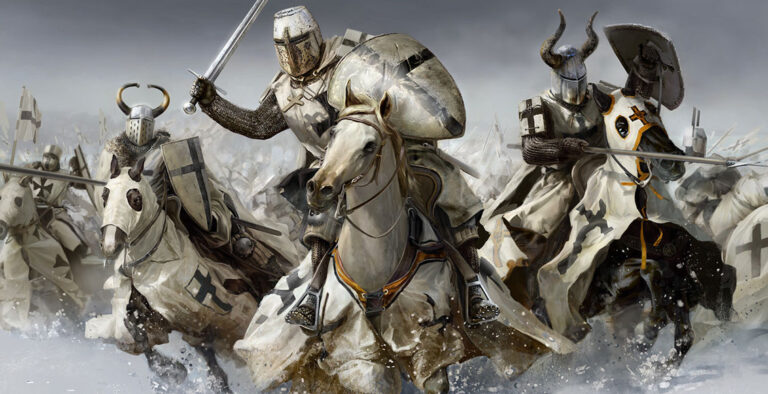

On July 15, 1410, two mighty armies faced each other on the fields of Grunwald. On one side stood the forces of the Teutonic Order, commanded by Grand Master Ulrich von Jungingen. On the other – the formidable, combined forces of the Kingdom of Poland and the Grand Duchy of Lithuania, led by King Władysław Jagiełło.
As we well know, this monumental clash ended in a complete and crushing victory for the Polish-Lithuanian forces. The Teutonic forces were shattered, and nearly the entire elite of the Order fell on the battlefield. That single day decisively broke the military might of the Teutonic Order and forever changed the balance of power in medieval Europe.

In the decisive and most dramatic phase of the battle, the Grand Master of the Order himself fell. His death became the ultimate symbol of the Teutonic Knights’ defeat, but to this day, it remains shrouded in an intriguing mystery. Who dealt the final blow to one of the most powerful men in Europe at that time? Unfortunately, we cannot be absolutely certain of his name. However, based on the available sources, we can reconstruct the Grand Master’s final moments with great precision.
In the final moments of his life, seeing victory slipping from his grasp, von Jungingen personally led a charge of sixteen reserve banners. He hoped that with a single, massive blow, he would shatter the Polish lines and turn the tide of the clash on the fields of Grunwald. It was there, in the very cauldron of battle, amidst the deafening clash of steel and the neighing of horses, that Ulrich von Jungingen met his end. Historians confirm that the Teutonic reserve was halted almost instantly. In the very first clash, the elite of the Polish knights, fighting in the front ranks, inflicted devastating losses on the enemy, striking down many of the Order’s highest dignitaries – including the Grand Master himself.
Therefore, it is believed that von Jungingen fell not by the hand of a nameless foot soldier, but in direct combat with a Polish knight who stood in his path during that desperate charge. We even know the name of the warrior to whom this historic deed is attributed. It is believed to have been Mszczuj of Skrzynno, a knight of Władysław Jagiełło’s court banner. Why do the historical clues point specifically to him?

First of all, as chronicled by Jan Długosz, it was Mszczuj who informed the king of the Grand Master’s death. As proof, he presented the monarch with a golden pectoral containing holy relics, which his servant had stripped from the slain leader. According to the medieval rules of warfare, the equipment, armor, and mounts of a defeated knight became the spoils of his vanquisher. Furthermore, after the battle, the Grand Master’s rich garment was presented to the church in Kije. This church was closely connected to Mszczuj’s family and is believed to be the place of his baptism.
The case for Mszczuj is further supported by the fact that he served in the court banner, the very unit that clashed with the Teutonic reserve led personally by the Grand Master. Within this banner, Mszczuj fought as a front-rank knight, meaning he was positioned at the very head of the formation. Such a demanding role was entrusted only to the finest and most experienced Polish warriors.

Yet, despite all these compelling arguments, we must keep one thing in mind: these are still merely historical clues and circumstantial evidence, not definitive proof. Although Mszczuj of Skrzynno remains the most likely candidate to have slain the Grand Master, we will probably never know with absolute certainty exactly who ended his life.
The fundamental question remains: why don’t we know this? Accounts of the Battle of Grunwald, although generally very detailed, stubbornly omit the names of those who took the lives of the highest-ranking brothers of the Order.
Historians lean towards the theory that this was a cold, calculated political decision. The Poles and Lithuanians, vividly remembering years of bloody raids and Teutonic atrocities against civilian populations, showed no mercy on the fields of Grunwald. Slaughtering the Order’s entire elite – rather than taking them prisoner for a massive ransom, as was standard practice – was shocking, and even scandalous, to Christian Europe at the time. To avoid providing ammunition for diplomatic attacks, the names of the direct perpetrators were simply never publicized. Interestingly, on that very same battlefield, knights from Western Europe who had joined the Order as ‘guests’ were treated entirely differently; in accordance with chivalric custom, they were readily spared and taken for a lucrative ransom.
Ultimately, the identity of the man who struck the fatal blow to Ulrich von Jungingen remains yet another of the great mysteries concealed by the fields of Grunwald.